
Report on practical experiments in letter-carving
March 2026
The PI (Nora) and PhD researcher (Cassandra) spent a very informative and productive day recently experimenting with letter-carving under the guidance of stone sculptor and letter-carver Aileen Anne Brannigan (https://www.loveirishstone.com/).
On the EMISoS project, we are analysing the palaeography of inscriptions on cross-slabs and other, mainly stone, objects/monuments. It was hugely beneficial for us to experience what it is like to actually carve these letters using various different stone types, tools and methods, which helps us to better understand the development and choice of particular letter forms in early Irish epigraphy.
Aileen Anne had benches specially made for us in her workshop, supplied us with stone to work on, a selection of tools to work with and dust masks for working with certain stone types. We started off with what we later learned was the hardest stone to carve, of the three types tried over the course of the day. This was a smooth-surfaced, shaped block of limestone. She showed us how to properly hold and use the mallet and chisels and drew the outline of an I and an O for us to start with. We tried both punches and flat chisels – you really need the eye protection when using a punch! We practiced the v-cut quite a bit as it is hard to get the lines straight and the sides nice and even. Especially with a hard stone, it takes a while to get the carving deep enough.
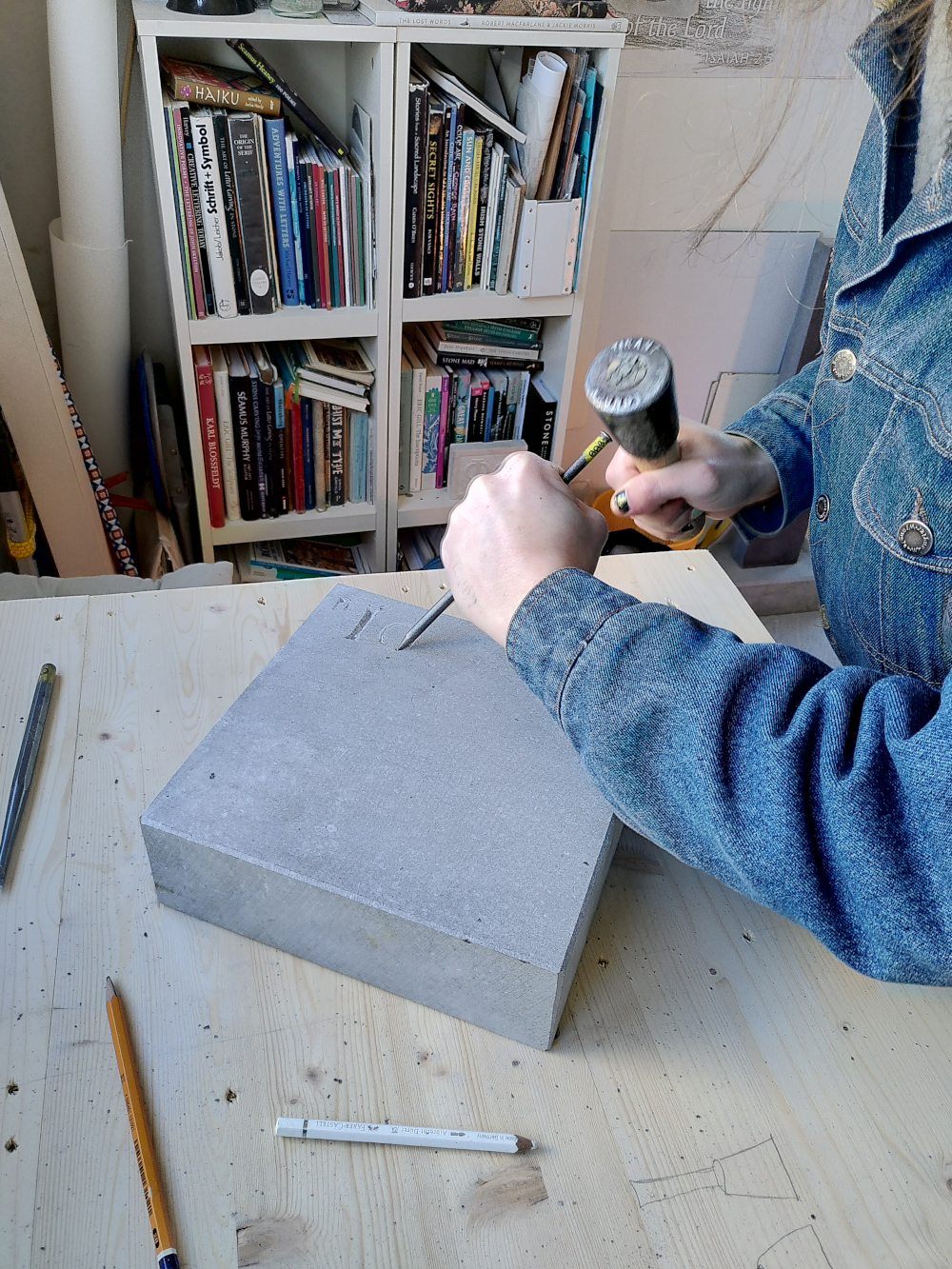
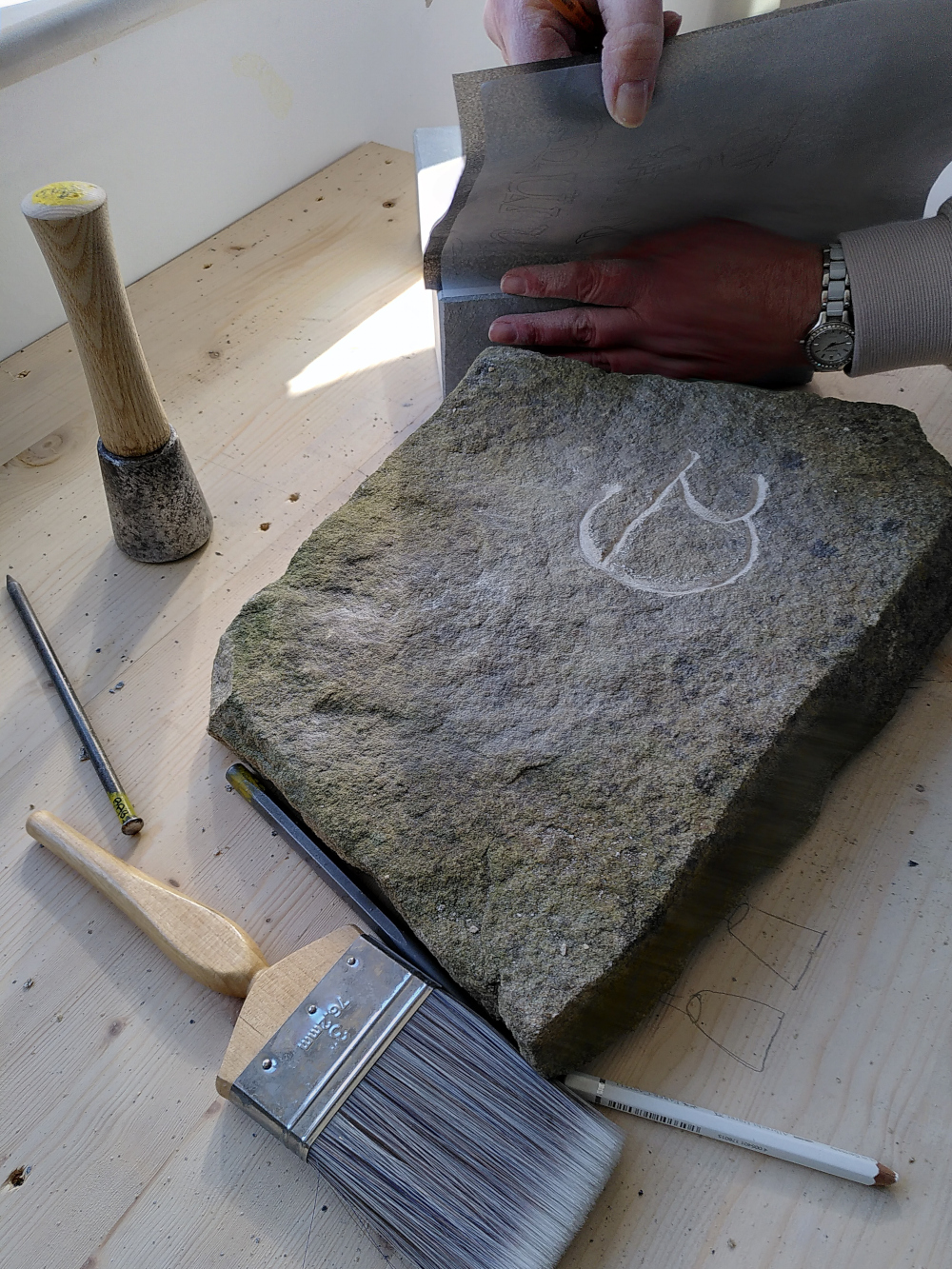
Letter carving on a limestone block Ligatured letters on a sandstone slab
Then Aileen Anne brought out a couple of slabs of rough-surfaced sandstone (and the dust masks). This time we tried carving ORT with a suspension stroke (for oróit ‘prayer’, a typical formula word found on early medieval inscribed cross-slabs)and ligatured ET. The stone was easier to work with than the limestone. It is a softer stone but sometimes the unprepared roughness of the surface meant it was difficult to keep lines straight. This was very useful to try, however, as some early inscriptions were done on unprepared surfaces. One advantage of the rough surface is that less than perfect letters don’t stand out as much as they do on the smooth surface of the limestone.
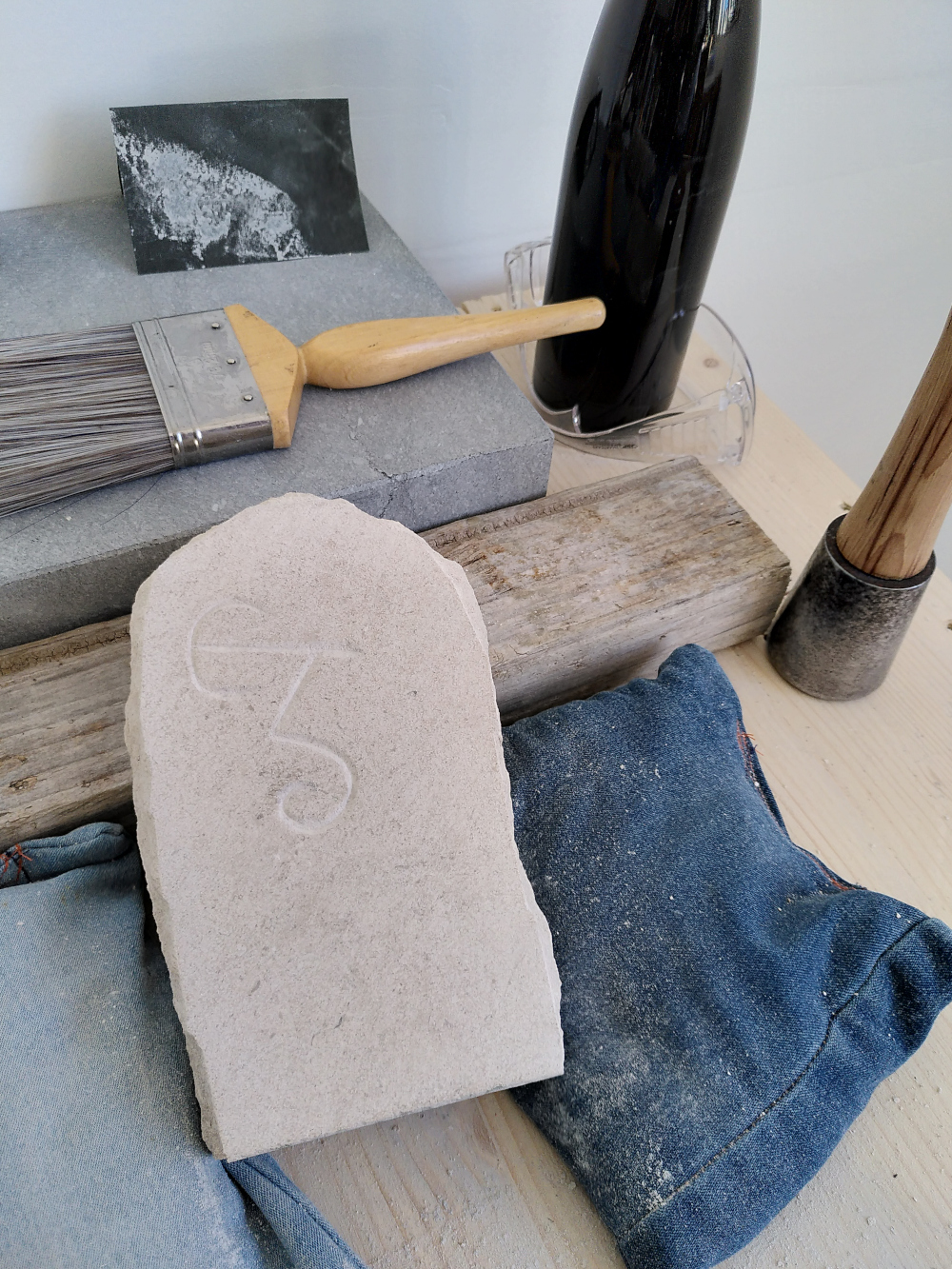
Letters carved into white Portuguese limestone
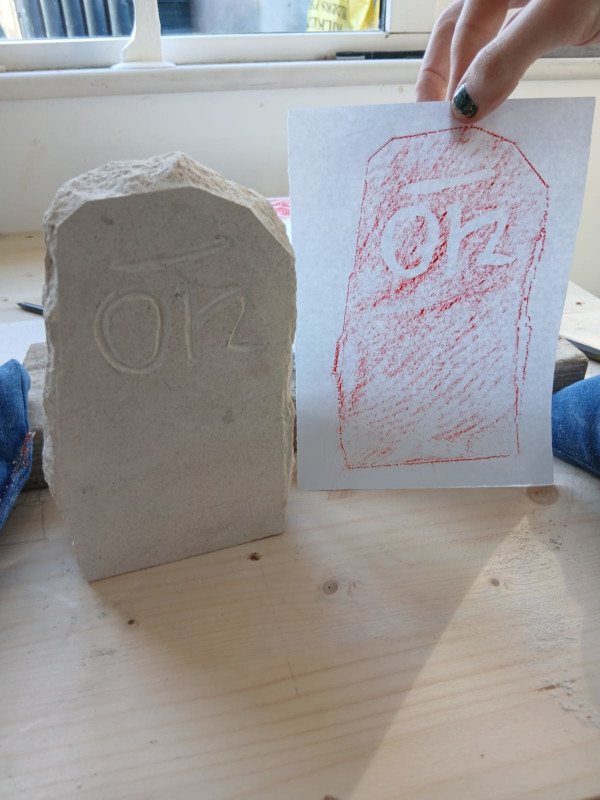
After lunch we started on the final stone type. This was another limestone, but this time a soft, white, Portuguese limestone. It also had a smooth surface but was much easier to carve. This is when Aileen Anne told us that she had deliberately started us with the most difficult stone to work with. We drew on to the white stones some further letter forms to try out: another OR with suspension stroke and ligatured EG (as on the Kilconriola cross-slab). On the backs of each we then added IN with Kilnasaggart type loops/serifs and an Inchagoill type cross with fish-tail terminals. Aileen Anne advised us where to buy tools to do more practical experiments and recommended specific chisels and mallets for starting off. We left with the three stones we had each worked on and a real sense of achievement.
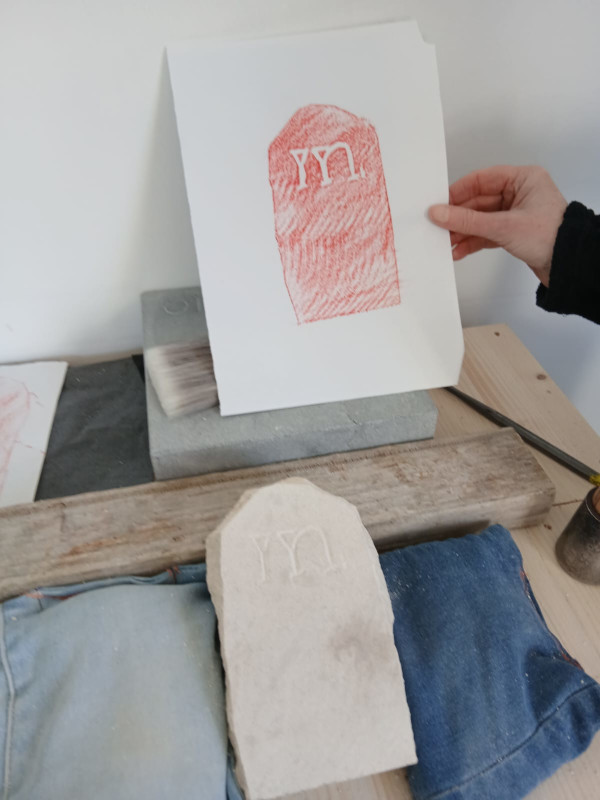
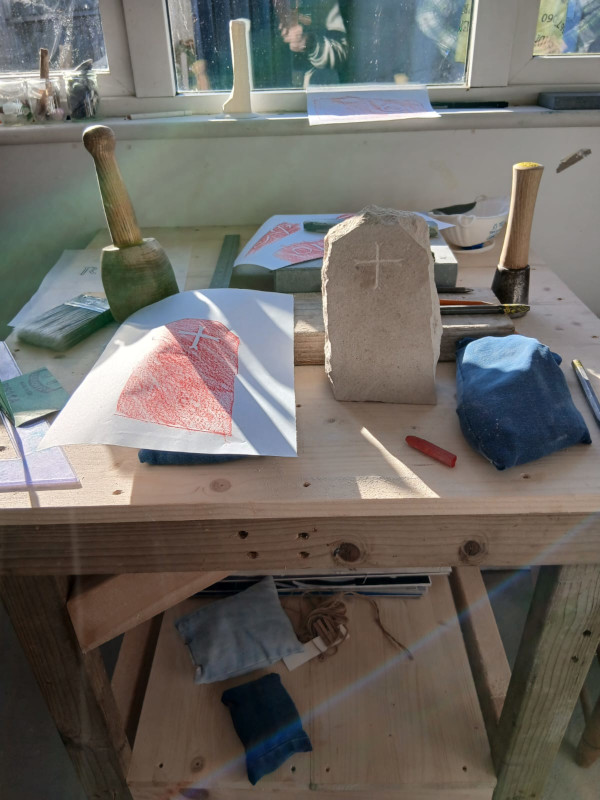
Final carved letters and cross on Portuguese limestone with tracings
Afterwards we discussed the experience and our thoughts on letter-carving, now that we had new insights on the techniques and challenges involved. We both agreed that making the v-cut is very difficult, as it requires you to have the chisel angled at the same pitch on both sides of the letter, using the same force to carve into the surface. While we had expected that curved lines would be more difficult to achieve than straight lines, it was eye opening to experience how much precision and manoeuvring/walking around the stone is required in order to obtain smooth curves (particularly in the letter O). Similarly, in order to achieve deliberate letter-ends, we had to be extremely careful with the angle of the chisel, rotating it just slightly as we struck it with the hammer. We have seen many early medieval inscriptions with letter-ends that are not very clear, and this gave us a new appreciation as to what is required of letter-carvers to ensure that the letter-ends are crisp (especially with fish-tail terminals, as in the Inchagoill-type cross). Wear and weathered in the intervening centuries have also to be taken into consideration.
One final observation was in regard to the aforementioned Kilnasaggart-type serifs: when we had looked at the inscription initially, we had postulated that, perhaps, the stone was left untouched within the triangular serif region because it was easier for the letter-carver to leave material than to remove it. However, after we experimented with doing so ourselves, and discussed it with the instructor, we realised how much more care, time, and effort must go into such a serif, compared to one for which all the material has been carved away. You have to be extra precise to ensure that you do not damage the internal triangle, carving away from it, while also not damaging the external triangular shape of the serif itself. Its being more difficult to carve makes it much more likely that this serif type was specifically chosen for its aesthetic value and not for practicality’s sake, which is a valuable insight that we may not have achieved if we had not tried to make it ourselves.
_______________________________________________________________________________________________
Editing Inscriptions with EpiDoc: Case Studies from Glasgow
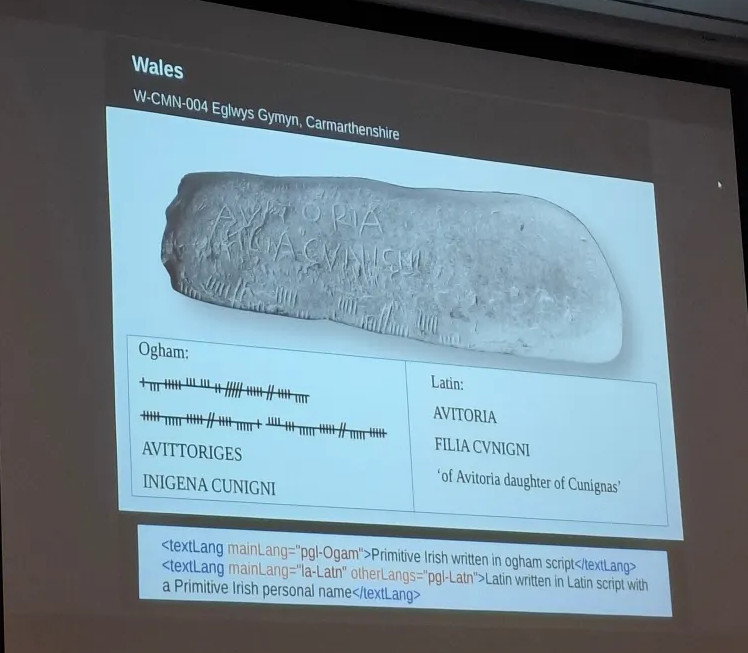
Thursday 11th December 2025, 2–4pm
Room 709A, Boyd Orr Building
Join us for TELab’s first event on epigraphy: the study of ancient inscriptions on a variety of different media. The session will showcase two Glasgow projects at different stages of development, each engaged in creating a digital edition using EpiDoc (the international standard for encoding ancient texts, especially inscriptions). Dr Alex Antoniou will present his work on editing inscriptions which concern the worship of the Roman emperor and his family in the Italian peninsula, while Dr Nora White (EMISoS Project, Maynooth University) will exhibit the recently published digital edition of inscriptions in a unique script from early medieval Ireland and Britain (Og(h)am project).
Please sign up for this event via Eventbrite here.
_______________________________________________________________________________________________
Digitising ancient and medieval texts: an introduction to EpiDoc
https://github.com/EpiDoc/Tutorials/wiki/Glasgow-Dec-2025
When: 9-11 December, 2025
Where: University of Glasgow
Taught by Alex Antoniou, Gabriel Bodard, Patricia O’Connor, Nora White.
EpiDoc is the de facto standard for the encoding of ancient epigraphic (including Ogham) and papyrological editions in TEI XML for online publication and interchange (epidoc.stoa.org). In this two-day, hands-on training workshop at the University of Glasgow (9–10 December), we will introduce the encoding of ancient and medieval texts in XML, and sources of information and support on EpiDoc. No technical knowledge is required, but participants are expected to be broadly familiar with the transcription conventions for inscriptions or papyri (e.g. the Leiden Conventions), and either Greek, Latin, Irish/Gaelic or the ancient language of their epigraphic or papyrological tradition.
_______________________________________________________________________________________________

Launch of O3D v2.0
When: Friday 12 September
Where: Royal Irish Academy, Dublin
The OG(H)AM project, a Collaborative Digital Humanities project funded by the UK Arts and Humanities Research Council and Taighde Éireann – Research Ireland (2021-2025), and closely related to the EMISoS project, has been digitally documenting all c. 500 extant objects inscribed in the ogham script. For the first time, the project has recorded ogham writing on all media (stone pillars and small portable objects on wood, bone, or metal), from all countries in which ogham is found (Ireland, Wales, England incl. Cornwall and Devon, Scotland and the northern islands, and the Isle of Man), and extending from its origin in the 4th century until the dawn of the modern revival c. 1850.
To celebrate the work and the achievements of the OG(H)AM project, the revised Ogham in 3D (O3D) digital corpus (ogham.celt.dias.ie/) was launched on Friday 12 September in the Royal Irish Academy as part of the conference Teangeolaíocht na Gaeilge 2025. The new database contains extensive multi-disciplinary information and documentation, including 3D recordings, of ogham inscriptions. The revised and enlarged metadata ensures searchability and accessibility of the data, and greatly expands its thematic, chronological, and geographical scope.
The programme of the launch consisted of the following short presentations:
- Nora White: The history of Ogham in 3D and the new database
- Katherine Forsyth: Ogham across the isles
- Megan Kasten: The digitisation of ogham
- Patricia O Connor: The encoding of ogham inscriptions
- David Stifter: The oghams in the National Museum of Ireland and new linguistic insights
- Deborah Hayden: Manuscript ogham and the Royal Irish Academy
- Katherine Forsyth & David Stifter: Outreach, acknowledgements, and concluding remarks
The OG(H)AM project (full title: Harnessing digital technologies to transform understanding of ogham writing, from the 4th century to the 21st) was a collaboration of researchers at the Universities of Glasgow and Maynooth. The Ogham in 3D website is hosted by the Dublin Institute for Advanced Studies.
__________________________________________________________________________________________

Digital Epigraphy Workshop:
3D imaging and EpiDoc XML training
(https://github.com/EpiDoc/Tutorials/wiki/Maynooth-May-2025)
When: Monday, May 26, 2025 – Wednesday, May 28, 2025.
Where: Trinity College Dublin and Maynooth University.
This three-day, in-person workshop introduced several digital approaches to the study of epigraphy—reading and publishing historical texts inscribed on stone or other durable materials, and recording the objects on which they are inscribed. We discussed and had the opportunity to practice two advanced imaging techniques: photogrammetry and reflectance transformation imaging, both of which use photography to capture 3D and other surface information of heritage objects. We also applied the encoding scheme EpiDoc (an implementation of TEI XML) to record the text and object description and history of inscriptions in Old Irish, Latin, Greek, Egyptian and other ancient languages.
The workshop, held in both Trinity College Dublin (Monday 26 May) and Maynooth University (27-28 May), was co-hosted by the EMISoS project (Maynooth University) and the Weingreen Museum/Department of Classics (Trinity College Dublin) in collaboration with Dr Gabriel Bodard (University of London). The training was led by Gabriel Bodard (London), Megan Kasten (Glasgow), Christine Morris (Trinity), Patricia O’Connor (Maynooth) and Nora White (Maynooth). The workshop also included two exceptional keynote lectures by Charlotte Roueché (King’s College London) and Pádraic Moran (University of Galway). Programme and keynote posters and abstracts below.
Programme
Keynote Lectures

